Central Air Conditioners are designed to remove heat and humidity from inside your home. The system consists of an evaporator coil located in the plenum above the furnace, a condenser unit located outside and refrigerant lines to connect the evaporator coil to condenser unit. The evaporator coil removes humidity and there is a drain pipe from the coil connecting to either a floor drain or a condensate pump. This drain pipe must be kept clear or flooding may occur around the furnace. The refrigerant lines carry a refrigerant gas (R22 or R410A) that collects the heat from inside the house and transfers that heat to the condenser outside. The condenser unit consists of a condenser coil to carry the Freon gas, a compressor to pump the Freon through the system and a fan to draw the outside air through the coil.
When summer comes, you may rely on the cooling powers of your AC to get you through those long, hot days. But what happens when that’s no longer an option? The only thing worse than a broken AC is one that won’t blow any cold air.
There may be several reasons why your air conditioner is working but not cooling, or why your AC is running but not blowing air full stop. Let’s take a closer look at some of the reasons below and how to follow some simple steps to get your AC back up and running.
If your air conditioner isn’t blowing cold air, the first step should be to check your thermostat. It may be that you just have it on the wrong setting. Make sure it is set to ‘On’ instead of ‘Auto’.
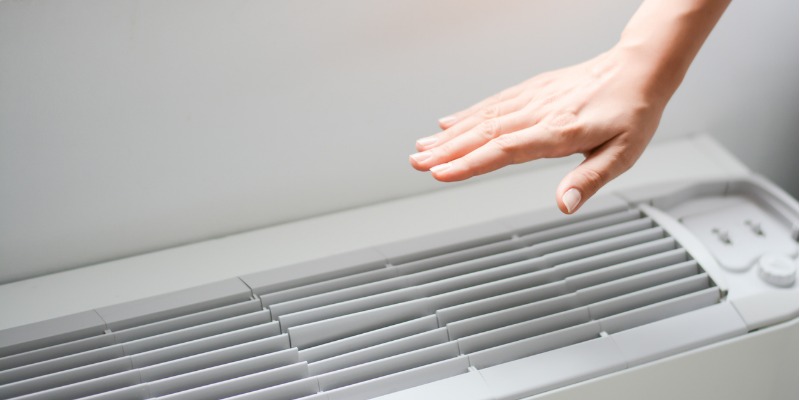
Then, try resetting your thermostat and programming the temperature a few degrees cooler than your house, say 20°C if your home is registering as 25°C. Wait a few minutes and put your hands over the vents to see if you can feel any cool air. It may have just needed a simple reset.
If you still don’t feel any cool air, there could be an internal wiring problem or a number of other issues, which you will need to fix with the help of a professional.
Another reason for your AC running but not blowing cool air could be your air filter. Check your filter for excess debris which can impede airflow, making your home feel warmer. A dirty air filter also stops air flowing back into the air conditioner, thus preventing it from cooling correctly.
If your filter is dirty, switch it for a new one and get into the habit of doing this monthly by setting a reminder for yourself.
If there isn’t enough refrigerant in your AC, it’s likely your air conditioner is blowing hot air, making your home feel warmer than usual. This decrease in cool air is generally the result of a refrigerant leak.
Signs of a leak could include an icy build-up on you’re A/C unit. Also, if your AC is still blowing cold air, it may take much longer to cool your home.
If you think you may have a leak, stop using your AC immediately and contact a professional to have it inspected.
Evaporator coils will get dirty over time. This can affect the overall performance of your AC and make it harder for it to remove warm air. It could end up overheating and shutting off, resulting in your AC running but not blowing air at all.
Evaporator coils should be cleaned by an experienced HVAC professional.
Keep up with regular maintenance to avoid unwanted breakdowns and unnecessary problems from occurring. Contact Appleby Systems for professional help with your AC today and avoid being left with an air conditioner not blowing cold air this summer!